Greetings everyone~
The nominations are in and here are the descriptions! We will be voting for six books at Claudia's on , so please review the list and compile your list of favorites:
Cutting for Stone-Abraham Verhese
Review from Publisher's Weekly:
Lauded

for his sensitive memoir (
My Own Country) about his time as a doctor in eastern Tennessee at the onset of the AIDS epidemic in the 80s, Verghese turns his formidable talents to fiction, mining his own life and experiences in a magnificent, sweeping novel that moves from India to Ethiopia to an inner-city hospital in New York City over decades and generations. Sister Mary Joseph Praise, a devout young nun, leaves the south Indian state of Kerala in 1947 for a missionary post in Yemen. During the arduous sea voyage, she saves the life of an English doctor bound for Ethiopia, Thomas Stone, who becomes a key player in her destiny when they meet up again at Missing Hospital in Addis Ababa. Seven years later, Sister Praise dies birthing twin boys: Shiva and Marion, the latter narrating his own and his brothers long, dramatic, biblical story set against the backdrop of political turmoil in Ethiopia, the life of the hospital compound in which they grow up and the love story of their adopted parents, both doctors at Missing. The boys become doctors as well and Vergheses weaving of the practice of medicine into the narrative is fascinating even as the story bobs and weaves with the power and coincidences of the best 19th-century novel.
http://www.amazon.com/Cutting-Stone-Abraham-Verghese/dp/0375714367/ref=sr_1_1?s=books&ie=UTF8&qid=1304520570&sr=1-1
In Cold Blood-Truman Capote Amazon review:"Unti

l one morning in mid-November of 1959, few Americans--in fact, few Kansans--had ever heard of Holcomb. Like the waters of the river, like the motorists on the highway, and like the yellow trains streaking down the Santa Fe tracks, drama, in the shape of exceptional happenings, had never stopped there." If all Truman Capote did was invent a new genre--journalism written with the language and structure of literature--this "nonfiction novel" about the brutal slaying of the Clutter family by two would-be robbers would be remembered as a trail-blazing experiment that has influenced countless writers. But Capote achieved more than that. He wrote a true masterpiece of creative nonfiction. The images of this tale continue to resonate in our minds: 16-year-old Nancy Clutter teaching a friend how to bake a cherry pie, Dick Hickock's black '49 Chevrolet sedan, Perry Smith's Gibson guitar and his dreams of gold in a tropical paradise--the blood on the walls and the final "thud-snap" of the rope-broken necks.
http://www.amazon.com/Cold-Blood-Truman-Capote/dp/0375507906/ref=sr_1_1?s=books&ie=UTF8&qid=1304520489&sr=1-1
The Guernsey Literary and Potato Pie Society-Mary Ann Shaffer & Annie BarrowsPublisher's Weekly:
The letters comprising this small charming novel begin in 1946, when single, 30-something author Juliet Ashton (nom de plume Izzy Bickerstaff) writes to her publisher to say she is tired of covering the sunny side of war and its aftermath. When Guernsey farmer Dawsey Adams finds Juliet's name in a used book and invites articulate—and not-so-articulate—neighbors to write Juliet with their stories, the book's epistolary circle widens, putting Juliet back in the path of war stories. The occasionally contrived letters jump from incident to incident—including the formation of the Guernsey Literary and Potato Peel Pie Society while Guernsey was under German occupation—and person to person in a manner that feels disjointed. But Juliet's quips are so clever, the Guernsey inhabitants so enchanting and the small acts of heroism so vivid and moving that one forgives the authors (Shaffer died earlier this year) for not being able to settle on a single person or plot. Juliet finds in the letters not just inspiration for her next work, but also for her life—as will readers.
http://www.amazon.com/gp/product/0385341008/ref=s9_simh_bw_p14_d0_i1?pf_rd_m=ATVPDKIKX0DER&pf_rd_s=center-3&pf_rd_r=0MY0V3DYJKX8CCFF4H7C&pf_rd_t=101&pf_rd_p=1287771322&pf_rd_i=283155
Room: A Novel-Emma DonaghueAmazon:
Five-year-old Jack and his Ma live and eat and play and sleep in one room--an 11×11-foot space that is their prison--captives of the terrifying man Jack calls Old Nick. But as Jack grows older and more curious, it becomes clear that the room will not be able to hold him and Ma forever. Michal Friedman shines as Jack; her narration is haunting and compelling in its every inflection and tone. The voice she creates for Jack is so convincing, listeners may even mistake her for an actual child. Her powerful performance is complemented by Robert Petcoff's sinister Old Nick, and Ellen Archer's portrayal of resourceful Ma, whose gentle voice is infused with patience, terror, and hope. The chemistry between the players creates a gem of an audiobook that will haunt listeners long after the story's end.
http://www.amazon.com/Room-Novel-Emma-Donoghue/dp/0316098329/ref=sr_1_1?s=books&ie=UTF8&qid=1304517582&sr=1-1
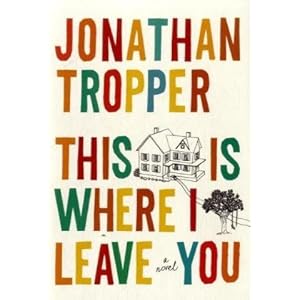
This is Where I Leave You-Jonathan Tropper Amazon:
Tropper returns with a snappy and heartfelt family drama/belated coming-of-age story. Judd Foxman's wife, Jen, has left him for his boss, a Howard Stern–like radio personality, but it is the death of his father and the week of sitting shivah with his enjoyably dysfunctional family that motivates him. Jen's announcement of her pregnancy—doubly tragic because of a previous miscarriage—is followed by the dramas of Judd's siblings: his sister, Wendy, is stuck in an emotionless marriage; brother Paul—always Judd's defender—and his wife struggle with infertility; and the charming youngest, Phillip, attempts a grown-up relationship that only highlights his rakishness. Presided over by their mother, a celebrated parenting expert despite her children's difficulties, the mourning period brings each of the family members to unexpected epiphanies about their own lives and each other. The family's interactions are sharp, raw and often laugh-out-loud funny, and Judd's narration is unflinching, occasionally lewd and very keen. Tropper strikes an excellent balance between the family history and its present-day fallout, proving his ability to create touchingly human characters and a deliciously page-turning story.
http://www.amazon.com/This-Where-I-Leave-You/dp/B003JTHRGE/ref=sr_1_1?s=books&ie=UTF8&qid=1304517464&sr=1-1
Map of Love-Ahdaf SoueifAmazon:
In 1997, Isabel Parkman, a recently divorced American journalist, travels to Egypt to research about the impending millennium. But her interest in Egypt has more to do with her crush on Omar al-Ghamrawi, a passionate and difficult older Egyptian-American conductor and political writer, than with her work. Once in Egypt, Isabel neglects her project for a more personal investigation. Lugging with her a mysterious trunk of papers bequeathed to her by her mother, Isabel turns up at Omar's sister Amal's house in Cairo and explains that Omar had said she might be interested in translating the papers. As the two soon discover, Isabel is Amal's distant cousin, and the papers belonged to their mutual great-grandmother, Anna Winterbourne. As a young English widow, Anna traveled to turn-of-the-century Egypt, then an English colony, and fell in love with an Egyptian man. "I cannot help thinking that when she chose to step off the well-trodden paths of expatriate life, Anna must have secretly wanted something out of the ordinary to happen to her," muses Amal, who begins to realize that the same applies to her own life. Soueif (In the Eye of the
Sun) writes simply and, on occasion, beautifully. Anna's journal entries are particularly evocative. Sticklers for narrative detail might chafe at the number of incredible coincidences, including a bizarre twist involving Isabel's mother and Omar, and forsaken plot devices (Isabel's millennium project is never mentioned after her arrival in Egypt). On balance, however, Soueif weaves the stories of three formidable women from vastly different times and countries into a single absorbing tale.
http://www.amazon.com/Map-Love-Novel-Ahdaf-Soueif/dp/0385720114
The Art of Racing in the Rain-Garth SteinPublisher's Weekly:
If you've ever wondered what your dog is thinking, Stein's third novel offers an answer. Enzo is a lab terrier mix plucked from a farm outside Seattle to ride shotgun with race car driver Denny Swift as he pursues success on the track and off. Denny meets and marries Eve, has a daughter, Zoë, and risks his savings and his life to make it on the professional racing circuit. Enzo, frustrated by his inability to speak and his lack of opposable thumbs, watches Denny's old racing videos, coins koanlike aphorisms that apply to both driving and life, and hopes for the day when his life as a dog will be over and he can be reborn a man. When Denny hits an extended rough patch, Enzo remains his most steadfast if silent supporter. Enzo is a reliable companion and a likable enough narrator, though the string of Denny's bad luck stories strains believability. Much like Denny, however, Stein is able to salvage some dignity from the over-the-top drama.
http://www.amazon.com/Art-Racing-Rain-Novel/dp/0061537969/ref=ntt_at_ep_dpi_1
Angle of Repose-Wallace Stegnerfrom the publisher: Angle of Repose
 tells the story of Lyman Ward, a retired professor of history and author of books about the Western frontier, who returns to his ancestral home of Grass Valley, California, in the Sierra Nevada. Wheelchair-bound with a crippling bone disease and dependent on others for his every need, Ward is nonetheless embarking on a search of monumental proportions — to rediscover his grandmother, now long dead, who made her own journey to Grass Valley nearly a hundred years earlier. Like other great quests in literature, Lyman Ward's investigation leads him deep into the dark shadows of his own life.
http://www.amazon.com/gp/product/014016930x/ref=dp_proddesc_1?ie=UTF8&n=283155
City of Thieves-David BenioffPublisher's Weekly:
Author and screenwriter Benioff follows up
The 25th Hour with this hard-to-put-down novel based on his grandfather's stories about surviving WWII in Russia. Having elected to stay in Leningrad during the siege, 17-year-old Lev Beniov is caught looting a German paratrooper's corpse. The penalty for this infraction (and many others) is execution. But when Colonel Grechko confronts Lev and Kolya, a Russian army deserter also facing execution, he spares them on the condition that they acquire a dozen eggs for the colonel's daughter's wedding cake. Their mission exposes them to the most ghoulish acts of the starved populace and takes them behind enemy lines to the Russian countryside. There, Lev and Kolya take on an even more daring objective: to kill the commander of the local occupying German forces. A wry and sympathetic observer of the devastation around him, Lev is an engaging and self-deprecating narrator who finds unexpected reserves of courage at the crucial moment and forms an unlikely friendship with Kolya, a flamboyant ladies' man who is coolly reckless in the face of danger. Benioff blends tense adventure, a bittersweet coming-of-age and an oddly touching buddy narrative to craft a smart crowd-pleaser.
http://www.amazon.com/City-Thieves-Novel-David-Benioff/dp/0452295297/ref=tmm_pap_title_0?ie=UTF8&qid=1304648058&sr=1-1
Anil's Ghost by Michael OndaatjePublisher's Weekly:
While he is generally considered a Canadian writer, Booker Prize-winner Ondaatje was born in Sri Lanka, and he has chosen to set his powerful and resonant new novel in that country during its gruesome civil war in the mid-1980s. Written in his usual cryptic, elliptical style, much of the story is told in flashbacks, with Ondaatje hinting at secrets even as he divulges facts, revealing his characters' motivations through their desperate or passionate behavior and, most of all, conveying the essence of a people, a country and its history via individual stories etched against a background of natural beauty and human brutality. Anil Tessira, a 33-year-old native Sri Lankan who left her country 15 years before, is a forensic pathologist sent by the U.N. human rights commission to investigate reports of mass murders on the island. Atrocities are being committed by three groups: the government, anti-government insurgents, and separatist guerrillas. Working secretly, these warring forces are decimating a population paralyzed by pervasive fear. Taciturn archeologist Sarath Diyasena is assigned by the government to be Anil's partner; at 49, he is emotionally withdrawn from the chaotic contemporary world, reserving his passion for the prehistoric shards of his profession. Together, Anil and Sarath discover that a skeleton interred among ancient bones in a government-protected sanctuary is that of a recently killed young man. Anil defiantly sets out to document this murder by identifying the victim and then making an official report. Throughout their combined forensic and archeological investigation, detailed by Ondaatje with the meticulous accuracy readers will remember from descriptions of the bomb sapper's procedures in The English Patient, Sarath remains a mysterious figure to Anil. Her confusion about his motives is reinforced when she meets his brother, Gamini, an emergency room doctor who is as intimately involved in his country's turmoil as Sarath refuses to be. The lives of these characters, and of others in their orbits, emerge circuitously, layer by layer. In the end, Anil's moral indignation--and her innocence--place her in exquisite danger, and Sarath is moved to a life-defining sacrifice. Here the narrative, whose revelations have been building with a quiet ferocity, assumes the tension of a thriller, its chilling insights augmented by the visceral emotional effects that masterful literature can provide. More effective than a documentary, Ondaatje's novel satisfies one of the most exalted purposes of fiction: to illuminate the human condition through pity and terror. It may well be the capstone of his career.
http://www.amazon.com/Anils-Ghost-Novel-Michael-Ondaatje/dp/0375724370/ref=sr_1_1?s=books&ie=UTF8&qid=1305070203&sr=1-1
A Legacy by Sybille Bedfordfrom the dust jacket:
The Kaiser's Germany is the setting of Sybille Bedford's first and best-known novel, in which two families — one from solid, upholstered Jewish Berlin, the other from the somnolent, agrarian Catholic South — become comically, tragically, irrevocably intertwined. "Each family", writes the author, "stood confident of being able to go on with what was theirs, while in fact they were playthings, often victims, of the now united Germany and what was brewing therein". Did the monstrous thing that followed have its foundation in families such as these? "Writing about them made me think so. Hence the title".
http://www.amazon.com/Legacy-Novel-Sybille-Bedford/dp/1582431426/ref=sr_1_1?ie=UTF8&s=books&qid=1305070481&sr=1-1
The Hare with Amber Eyes by Edward de WaalPublisher's Weekly:
In this family history, de Waal, a potter and curator of ceramics at the Victoria & Albert Museum, describes the experiences of his family, the Ephrussis, during the turmoil of the 20th century. Grain merchants in Odessa, various family members migrated to Vienna and Paris, becoming successful bankers. Secular Jews, they sought assimilation in a period of virulent anti-Semitism. In Paris, Charles Ephrussi purchased a large collection of Japanese netsuke, tiny hand-carved figures including a hare with amber eyes. The collection passed to Viktor Ephrussi in Vienna and became the family's greatest legacy. Loyal citizens of the Austro-Hungarian Empire, the Vienna Ephrussis were devastated by the outcome of WWI and were later driven from their home by the imposition of Nazi rule over Austria. After WWII, they discovered that their maid, Anna, had preserved the netsuke collection, which Ignace Ephrussi inherited, and he settled in postwar Japan. Today, the netsuke reside with de Waal (descended from the family's Vienna branch) and serve as the embodiment of his family history. A somewhat rambling narrative with special appeal to art historians, this account is nonetheless rich in drama and valuable anecdote.
http://www.amazon.com/Hare-Amber-Eyes-Familys-Century/dp/0374105979/ref=sr_1_1?s=books&ie=UTF8&qid=1305070861&sr=1-1
Middlemarch by George EliotReview:
Dorothea Brooke can find no acceptable outlet for her talents or energy and few who share her ideals. As an upper middle-class woman in Victorian England she can't learn Greek or Latin simply for herself; she certainly can't become an architect or have a career; and thus, Dorothea finds herself "Saint Theresa of nothing." Believing she will be happy and fulfilled as "the lampholder" for his great scholarly work, she marries the self-centered intellectual Casaubon, twenty-seven years her senior. Dorothea is not the only character caught by the expectations of British society in this huge, sprawling book.
Middlemarch stands above its large and varied fictional community, picking up and examining characters like a jeweler observing stones. There is Lydgate, a struggling young doctor in love with the beautiful but unsuitable Rosamond Vincy; Rosamond's gambling brother Fred and his love, the plain-speaking Mary Garth; Will Ladislaw, Casaubon's attractive cousin, and the ever-curious Mrs. Cadwallader. The characters mingle and interact, bowing and turning in an intricate dance of social expectations and desires. Through them George Eliot creates a full, textured picture of life in provincial nineteenth-century England.
http://www.amazon.com/Middlemarch-Oneworld-Classics-George-Eliot/dp/1847490174/ref=sr_1_1?s=books&ie=UTF8&qid=1305071133&sr=1-1
Brave New World by Aldous HuxleyAmazon review:
"Community, Identity, Stability" is the motto of Aldous Huxley's utopian World State. Here everyone consumes daily grams of soma, to fight depression, babies are born in laboratories, and the most popular form of entertainment is a "Feelie," a movie that stimulates the senses of sight, hearing, and touch. Though there is no violence and everyone is provided for, Bernard Marx feels something is missing and senses his relationship with a young women has the potential to be much more than the confines of their existence allow. Huxley foreshadowed many of the practices and gadgets we take for granted today--let's hope the sterility and absence of individuality he predicted aren't yet to come.
http://www.amazon.com/Brave-New-World-Aldous-Huxley/dp/0060850523/ref=sr_1_1?s=books&ie=UTF8&qid=1305071457&sr=1-1
Freedom by Jonathan FranzenPublisher's Weekly:
Nine years after winning the National Book Award, Franzen's The Corrections consistently appears on "Best of the Decade" lists and continues to enjoy a popularity that borders on the epochal, so much so that the first question facing Franzen's feverishly awaited follow-up is whether it can find its own voice in its predecessor's shadow. In short: yes, it does, and in a big way. Readers will recognize the strains of suburban tragedy afflicting St. Paul, Minn.'s Walter and Patty Berglund, once-gleaming gentrifiers now marred in the eyes of the community by Patty's increasingly erratic war on the right-wing neighbors with whom her eerily independent and sexually precocious teenage son, Joey, is besot, and, later, "greener than Greenpeace" Walter's well-publicized dealings with the coal industry's efforts to demolish a West Virginia mountaintop. The surprise is that the Berglunds' fall is outlined almost entirely in the novel's first 30 pages, freeing Franzen to delve into Patty's affluent East Coast girlhood, her sexual assault at the hands of a well-connected senior, doomed career as a college basketball star, and the long-running love triangle between Patty, Walter, and Walter's best friend, the budding rock star Richard Katz. By 2004, these combustible elements give rise to a host of modern predicaments: Richard, after a brief peak, is now washed up, living in Jersey City, laboring as a deck builder for Tribeca yuppies, and still eyeing Patty. The ever-scheming Joey gets in over his head with psychotically dedicated high school sweetheart and as a sub-subcontractor in the re-building of postinvasion Iraq. Walter's many moral compromises, which have grown to include shady dealings with Bush-Cheney cronies (not to mention the carnal intentions of his assistant, Lalitha), are taxing him to the breaking point. Patty, meanwhile, has descended into a morass of depression and self-loathing, and is considering breast augmentation when not working on her therapist-recommended autobiography. Franzen pits his excavation of the cracks in the nuclear family's facade against a backdrop of all-American faults and fissures, but where the book stands apart is that, no longer content merely to record the breakdown, Franzen tries to account for his often stridently unlikable characters and find where they (and we) went wrong, arriving at--incredibly--genuine hope.
http://www.amazon.com/Freedom-Novel-Oprahs-Book-Club/dp/0312600844/ref=sr_1_1?s=books&ie=UTF8&qid=1305071782&sr=1-1
The Corrections by Jonathan FranzenPublisher's Weekly:
If some authors are masters of suspense, others postmodern verbal acrobats, and still others complex-character pointillists, few excel in all three arenas. In his long-awaited third novel, Franzen does. Unlike his previous works, The 27th City (1988) and Strong Motion (1992), which tackled St. Louis and Boston, respectively, this one skips from city to city (New York; St. Jude; Philadelphia; Vilnius, Lithuania) as it follows the delamination of the Lambert family Alfred, once a rigid disciplinarian, flounders against Parkinson's-induced dementia; Enid, his loyal and embittered wife, lusts for the perfect Midwestern Christmas; Denise, their daughter, launches the hippest restaurant in Philly; and Gary, their oldest son, grapples with depression, while Chip, his brother, attempts to shore his eroding self-confidence by joining forces with a self-mocking, Eastern-Bloc politician. As in his other novels, Franzen blends these personal dramas with expert technical cartwheels and savage commentary on larger social issues, such as the imbecility of laissez-faire parenting and the farcical nature of U.S.-Third World relations. The result is a book made of equal parts fury and humor, one that takes a dry-eyed look at our culture, at our pains and insecurities, while offering hope that, occasionally at least, we can reach some kind of understanding. This is, simply, a masterpiece.
http://www.amazon.com/Corrections-Novel-Jonathan-Franzen/dp/0312421273/ref=sr_1_1?s=books&ie=UTF8&qid=1305071995&sr=1-1
Beautiful Boy by David SheffAmazon review:
From as early as grade school, the world seemed to be on Nic Sheff's string. Bright and athletic, he excelled in any setting and appeared destined for greatness. Yet as childhood exuberance faded into teenage angst, the precocious boy found himself going down a much different path. Seduced by the illicit world of drugs and alcohol, he quickly found himself caught in the clutches of addiction.
Beautiful Boy is Nic's story, but from the perspective of his father, David. Achingly honest, it chronicles the betrayal, pain, and terrifying question marks that haunt the loved ones of an addict. Many respond to addiction with a painful oath of silence, but David Sheff opens up personal wounds to reinforce that it is a disease, and must be treated as such. Most importantly, his journey provides those in similar situations with a commodity that they can never lose: hope.
http://www.amazon.com/Beautiful-Boy-Fathers-Journey-Addiction/dp/B001VEHZYS/ref=sr_1_1?s=books&ie=UTF8&qid=1305113594&sr=1-1
Caleb's Crossing by Geraldine Brooksfrom the book:
Once again, Geraldine Brooks takes a remarkable shard of history and brings it to vivid life. In 1665, a young man from Martha's Vineyard became the first Native American to graduate from Harvard College. Upon this slender factual scaffold, Brooks has created a luminous tale of love and faith, magic and adventure.
The narrator of
Caleb's Crossing is Bethia Mayfield, growing up in the tiny settlement of Great Harbor amid a small band of pioneers and Puritans. Restless and curious, she yearns after an education that is closed to her by her sex. As often as she can, she slips away to explore the island's glistening beaches and observe its native Wampanoag inhabitants. At twelve, she encounters Caleb, the young son of a chieftain, and the two forge a tentative secret friendship that draws each into the alien world of the other. Bethia's minister father tries to convert the Wampanoag, awakening the wrath of the tribe's shaman, against whose magic he must test his own beliefs. One of his projects becomes the education of Caleb, and a year later, Caleb is in Cambridge, studying Latin and Greek among the colonial elite. There, Bethia finds herself reluctantly indentured as a housekeeper and can closely observe Caleb's crossing of cultures.
Like Brooks's beloved narrator Anna in
Year of Wonders, Bethia proves an emotionally irresistible guide to the wilds of Martha's Vineyard and the intimate spaces of the human heart. Evocative and utterly absorbing,
Caleb's Crossing further establishes Brooks's place as one of our most acclaimed novelists.
http://www.amazon.com/Calebs-Crossing-Novel-Geraldine-Brooks/dp/0670021040/ref=sr_1_1?s=books&ie=UTF8&qid=1305113845&sr=1-1
The Last Days of the Incas by Kim MacQuarriePublisher's Weekly:
With vivid and energetic prose, Emmy Award–winner and author MacQuarrie (
From the Andes to the Amazon) re-creates the 16th-century struggle for what would become modern-day Peru. The Incas ruled a 2,500–mile-long empire, but Spanish explorers, keen to enrich the crown and spread the Catholic Church, eventually destroyed Inca society. MacQuarrie, who writes with just the right amount of drama ("After the interpreter finished delivering the speech, silence once again gripped the square"), is to be commended for giving a balanced account of those events. This long and stylish book doesn't end with the final 1572 collapse of the Incas. Fast-forwarding to the 20th century, MacQuarrie tells the surprisingly fascinating story of scholars' evolving interpretations of Inca remains. In 1911, a young Yale professor of Latin American history named Hiram Bingham identified Machu Picchu as the nerve center of the empire. Few questioned Bingham's theory until after his death in 1956; in the 1960s Gene Savoy discovered the real Inca center of civilization, Vilcabamba. Although MacQuarrie dedicates just a few chapters to modern research, the archeologists who made the key discoveries emerge as well-developed characters, and the tale of digging up the empire is as riveting as the more familiar history of Spanish conquest.
http://www.amazon.com/Last-Days-Incas-Kim-MacQuarrie/dp/0743260503/ref=sr_1_1?s=books&ie=UTF8&qid=1305320335&sr=1-1
Saving Fish from Drowning by Amy TanPublisher's Weekly:San F

rancisco socialite and art-world doyenne Bibi Chen has planned the vacation of a lifetime along the notorious Burma Road for 12 of her dearest friends. Violently murdered days before takeoff, she's reduced to watching her friends bumble through their travels from the remove of the spirit world. Making the best of it, the 11 friends who aren't hung over depart their Myanmar resort on Christmas morning to boat across a misty lake—and vanish. The tourists find themselves trapped in jungle-covered mountains, held by a refugee tribe that believes Rupert, the group's surly teenager, is the reincarnation of their god Younger White Brother, come to save them from the unstable, militaristic Myanmar government. Tan's travelers, who range from a neurotic hypochondriac to the debonair, self-involved host of a show called
The Fido Files, fight and flirt among themselves. While ensemble casting precludes the intimacy that characterizes Tan's mother-daughter stories, the book branches out with a broad plot and dynamic digressions. It's based on a true story, and Tan seems to be having fun with it, indulging in the wry, witty voice of Bibi while still exploring her signature questions of fate, connection, identity and family.
http://www.amazon.com/Saving-Fish-Drowning-Amy-Tan/dp/B002GJU418/ref=sr_1_1?s=books&ie=UTF8&qid=1305320574&sr=1-1
The Element by Sir Kenneth RobinsonPublisher's Weekly:
Robinson (
Out of Our Minds), renowned in the areas of creativity development, innovation and human resources, tackles the challenge of determining and pursuing work that is aligned with individual talents and passions to achieve well-being and success. The element is what he identifies as the point where the activities individuals enjoy and are naturally good at come together. Offering a wide range of stories about the creative journeys of different people with diverse paths to the element—including Paul McCartney,
The Alchemist author Paulo Coelho, and Vidal Sassoon as well as lesser-known examples—he demonstrates a rich vision of human ability and creativity. Covering such topics as the power of creativity, circles of influence, and attitude and aptitude, the author emphasizes the importance of nurturing talent along with developing an understanding of how talent expresses itself differently in every individual. Robinson emphasizes the importance of mentors and reforming and transforming education, making a convincing argument bolstered by solid strategies for honing creativity. Motivating and persuasive, this entertaining and inspiring book will appeal to a wide audience.
http://www.amazon.com/Element-Finding-Passion-Changes-Everything/dp/0143116738/ref=sr_1_1?s=books&ie=UTF8&qid=1305320870&sr=1-1
Three Cups of Tea by Greg MortensonPublisher's Weekly:
Some failures lead to phenomenal successes, and this American nurse's unsuccessful attempt to climb K2, the world's second tallest mountain, is one of them. Dangerously ill when he finished his climb in 1993, Mortenson was sheltered for seven weeks by the small Pakistani village of Korphe; in return, he promised to build the impoverished town's first school, a project that grew into the Central Asia Institute, which has since constructed more than 50 schools across rural Pakistan and Afghanistan. Coauthor Relin recounts Mortenson's efforts in fascinating detail, presenting compelling portraits of the village elders, con artists, philanthropists, mujahideen, Taliban officials, ambitious school girls and upright Muslims Mortenson met along the way. As the book moves into the post-9/11 world, Mortenson and Relin argue that the United States must fight Islamic extremism in the region through collaborative efforts to alleviate poverty and improve access to education, especially for girls. Captivating and suspenseful, with engrossing accounts of both hostilities and unlikely friendships, this book will win many readers' hearts.
http://www.amazon.com/Three-Cups-Tea-Mission-Promote/dp/0143038257/ref=sr_1_1?s=books&ie=UTF8&qid=1305321137&sr=1-1
Battle Hymn of the Tiger Mother by Amy ChuaBookmarks:
Most critics agreed that
Battle Hymn of the Tiger Mother is an entertaining read—lively and humorous, written with the intent to shock. More controversial is Chua’s stereotyping of Chinese and Western cultures, not to mention her authoritarian parenting methods. Critics judged the book largely by asking the following questions: Should self-esteem come before accomplishment, or accomplishment before self-esteem? If the latter, should it be achieved by threats and constant monitoring? Chua’s teenage daughters are undeniably accomplished, but at what emotional cost? While some reviewers found that Chua’s technique borders on abuse and her writing was, at best, self-serving, others were impressed by her parenting results and opined that the West could learn a few things from this remarkably driven Chinese American mother.
http://www.amazon.com/Battle-Hymn-Tiger-Mother-Chua/dp/1594202842/ref=sr_1_1?s=books&ie=UTF8&qid=1305321263&sr=1-1
Dead Aid by Dambisi MoyoPublisher's Weekly:
In this important analysis of the past fifty years of international (largely American) aid to Africa, economist and former World Bank consultant Moyo, a native of Zambia, prescribes a tough dose of medicine: stopping the tide of money that, however well-intentioned, only promotes corruption in government and dependence in citizens. With a global perspective and on-the-ground details, Moyo reveals that aid is often diverted to the coffers of cruel despotisms, and occasionally conflicts outright with the interests of citizens-free mosquito nets, for instance, killing the market for the native who sells them. In its place, Moyo advocates a smarter, though admittedly more difficult, policy of investment that has already worked to grow the economies of poor countries like Argentina and Brazil. Moyo writes with a general audience in mind, and doesn't hesitate to slow down and explain the intricacies of, say, the bond market. This is a brief, accessible look at the goals and reasons behind anti-aid advocates, with a hopeful outlook and a respectful attitude for the well-being and good faith of all involved.
http://www.amazon.com/Dead-Aid-Working-Better-Africa/dp/1553655427/ref=sr_1_1?s=books&ie=UTF8&qid=1305321578&sr=1-1
 Well, we are once again on for book club, this upcoming Friday afternoon at 4:00 p.m. to be exact. Claudia Dumler will be hosting (directions below), so please RSVP to Claudia if you plan to attend. We will begin book club with discussion of Truman Capote's classic and upon completion of our discussion, we will then view the biopic Capote for which Philip Seymour Hoffman won an Oscar and which focuses a great deal upon his writing of In Cold Blood.